> ## Documentation Index
> Fetch the complete documentation index at: https://razorpay-881012b3.mintlify.site/llms.txt
> Use this file to discover all available pages before exploring further.
# Submit Investment Proofs
> Refer to the guide on how to submit investment proofs to reduce the tax liability.
export const VideoCard = props => {
const {title, href, videoUrl, children} = props;
const css = `
.rzp-vcard {
display: flex;
flex-direction: column;
overflow: hidden;
border: 1px solid rgba(0, 0, 0, 0.08);
border-radius: 0.75rem;
background: #fff;
height: 100%;
}
.rzp-vcard-video {
position: relative;
width: 100%;
aspect-ratio: 16 / 9;
background: #000;
}
.rzp-vcard-video iframe {
position: absolute;
inset: 0;
width: 100%;
height: 100%;
border: 0;
display: block;
}
.rzp-vcard-body { padding: 1rem 1.15rem 1.15rem; }
.rzp-vcard-title {
margin: 0 0 0.4rem;
font-size: 1rem;
font-weight: 600;
line-height: 1.4;
color: #0f172a;
}
.rzp-vcard-title a { color: inherit; text-decoration: none; }
.rzp-vcard-title a:hover { color: #3395ff; }
.rzp-vcard-desc { font-size: 0.875rem; line-height: 1.6; color: #475569; }
.rzp-vcard-desc > :first-child { margin-top: 0; }
.rzp-vcard-desc > :last-child { margin-bottom: 0; }
:where(.dark) .rzp-vcard {
border-color: rgba(255, 255, 255, 0.12);
background: rgba(255, 255, 255, 0.03);
}
:where(.dark) .rzp-vcard-title { color: #f1f5f9; }
:where(.dark) .rzp-vcard-desc { color: #94a3b8; }
`;
return
{videoUrl ?
: null}
{title ?
{href ? {title} : title}
: null}
{children}
Available in
🇮🇳 India
Investment declarations and proof submission is a critical payroll activity that enables employees to reduce their total tax liability. There are two aspects to this:
Employees declare those investments they have planned for the year which reduce their tax liability.
* Financial investments like NPS, PPF, insurance premium and others are exempt from tax up to a limit, which reduces the total taxable income.
* Employees can declare investments whenever the declaration window is open in Payroll.
* Proof of such investments are required towards the end of the year, usually between December to March.
Organisations open proof submission windows to enable employees to upload the proof of investments, as declared at the start of the year. These proofs are approved basis the verified proof amount, as per the organisation's policy. The approved amount can be independent of the originally declared amount.
Using the submitted proofs, organisations calculate the total taxable amount and the subsequent tax reduction. The proofs submitted ensure the correct amount of tax is deducted. The tax calculations then reflect in the employees' Form 16.
You can always correct your tax deductions when filing your Income Tax Returns (ITR).
**Handy Tips**
Investment proofs/tax proofs reduce the total taxable income via exemptions and deductions. TDS is calculated on the reduced income, which then reduces the tax liability.
Check how to declare and upload proofs when the proof upload window is open.
Know how to upload investment proofs as an employee on the Payroll Dashboard.
## Submit Proofs
Refer to the guidelines below to understand the proofs to submit for the respective components and investments.
The table below summarises how common predefined salary components are treated for income tax under the Old and New tax regimes. Use the search box to filter by component name, section or regime.
| Component | Exemption Section | Old Regime | New Regime | Limit or Calculation Rule |
| ----------------------------------------------- | ----------------- | ----------------------------- | ----------------------------- | ------------------------------------------------------------------------------------------------------------------------------------ |
| House Rent Allowance (HRA) | Section 10(13A) | Yes | No | Least of: actual HRA received; 50% of (Basic + DA) for metro cities or 40% for non-metro; rent paid minus 10% of (Basic + DA). |
| Leave Travel Allowance (LTA) | Section 10(5) | Yes | No | Two domestic journeys per four-year block. Current block runs January 1, 2026 to December 31, 2029. Economy class within India only. |
| Children Education Allowance | Section 10(14) | Yes | No | ₹100 per month per child, up to 2 children. |
| Hostel Expenditure Allowance | Section 10(14) | Yes | No | ₹300 per month per child, up to 2 children. |
| Transport Allowance (specially-abled employees) | Section 10(14) | Yes | Yes | ₹3,200 per month. |
| Conveyance Allowance (official duties) | Section 10(14) | Yes | Yes | Actual amount spent on official duties. |
| Books and Periodicals Reimbursement | Section 10(14) | Yes | Yes | Actual expense as per organisation policy. |
| Telephone and Internet Reimbursement | Section 10(14) | Yes | Yes | Actual expense as per organisation policy. |
| Meal Coupons or Vouchers | Section 17(2) | Yes | No | ₹50 per meal, up to ₹26,400 per year. |
| Gift Vouchers | Section 17(2) | Yes | Yes | Up to ₹5,000 per financial year. |
| Employer Provident Fund Contribution | Section 17(1) | Yes | Yes | Exempt up to 12% of Basic salary. |
| Employee Provident Fund Contribution | Section 80C | Yes | No | Counts within the overall ₹1,50,000 limit under Section 80C. |
| Employee NPS Contribution | Section 80CCD(1B) | Yes | No | Additional ₹50,000 over and above the Section 80C limit. |
| Employer NPS Contribution | Section 80CCD(2) | Yes (up to 10% of Basic + DA) | Yes (up to 14% of Basic + DA) | The higher 14% limit under the new regime applies to private sector employees from FY 2025-26 onwards. |
| Standard Deduction | Section 16(ia) | Yes (₹50,000) | Yes (₹75,000) | Applied automatically on salary income. |
| Professional Tax | Section 16(iii) | Yes | No | Actual amount paid, capped at ₹2,500 per year. |
| Gratuity (on retirement or termination) | Section 10(10) | Yes | Yes | Up to ₹20,00,000 lifetime limit for non-government employees. |
| Leave Encashment (on retirement) | Section 10(10AA) | Yes | Yes | Up to ₹25,00,000 lifetime limit for non-government employees. |
| Basic Salary | Not applicable | Fully taxable | Fully taxable | No exemption available. |
| Dearness Allowance (DA) | Not applicable | Fully taxable | Fully taxable | No exemption available. |
| Special Allowance | Not applicable | Fully taxable | Fully taxable | No exemption available. |
| Bonus or Performance Bonus | Not applicable | Fully taxable | Fully taxable | No exemption available. |
Click the respective tabs to understand the exemption criteria and the proofs accepted.
* HRA exemption is available only under the Old Tax Regime, under Section 10(13A). Under the New Tax Regime, HRA is fully taxable.
* The exempt amount is the least of the following three:
1. Actual HRA received from the employer.
2. 50% of (Basic + DA) for metro cities or 40% of (Basic + DA) for non-metro cities. Under the Income Tax Act, 2025 (effective FY 2026-27), the 50% metro rate applies to eight cities: Delhi, Mumbai, Chennai, Kolkata, Hyderabad, Pune, Ahmedabad and Bengaluru. For prior financial years under the Income Tax Act, 1961, only the original four (Delhi, Mumbai, Chennai, Kolkata) qualified.
3. Actual rent paid minus 10% of (Basic + DA).
* The city where you reside determines the metro or non-metro rate, not the city where your employer is located.
* The rented accommodation must not belong to you or your spouse.
* All rent receipts must:
* Bear your name, details of the accommodation such as addresses, amount of rent paid per month/quarter.
* Be duly signed by your landlord.
* Date from April/month you started renting the accommodation to March/month of the current financial year that you last rented the accommodation.
* You can submit both rent receipts or the rental agreement as proof of payment.
* You must submit owner's PAN if your monthly rent exceeds ₹8,333/- (₹1,00,000 per year).
Click the respective tabs to understand the exemption criteria and the proofs accepted.
* LTA exemption is available only under the Old Tax Regime. Under the New Tax Regime, the entire LTA component is taxed as salary.
* You can claim LTA two times in a span of 4 years (called a block).
* The current block runs from January 1, 2026 to December 31, 2029. You can claim two journeys within this block.
* If you did not exhaust both claims in the previous block (January 1, 2022 to December 31, 2025), you may carry forward one journey, which must be completed by December 31, 2026.
* You can claim LTA for one trip per calendar year.
* The journey undertaken must be on your organisation's working days. Vacations on organisation-allocated holidays are not considered. For example, Sundays.
* Only the travel cost is exempt. Hotel, stay and food expenses are not exempt.
* Only economy class travel by air, rail or public transport via the shortest route within India is eligible.
* Tickets/passes/invoices must bear your name.
* Every individual who undertook the journey must bear a separate ticket.
Scroll horizontally on the section names to view the proof submission guidelines.
* **Life Insurance Premium and Public Provident Fund (PPF) Contribution**:
* Premiums paid in the current financial year is exempt under section (u/s) 80C.
* Submit the receipt of premium paid.
* Only the premium paid and taxes is exempt. Late fees, taxes on late fees and more are not exempt.
* **National Savings Certificate (NSC)**:
* NSC is exempt upto ₹1.5 lakhs in a financial year. Submit a copy of proof of certificates along with the date of purchase and amount.
* Interest earned on NSC for the first four years is tax-exempt. It is taxable from the fifth year onwards.
* **ULIP/LIC Mutual Funds**:
* Submit a copy of the ULIP statements for all months invested.
* **Childrens' Tuition Expenditure**:
* Copy of receipts of the tuition and exam fees paid to any university/school/college.
* Excludes donations, development fees, bus, text books and uniform fees, private tuitions and more.
* Covers maximum 2 children.
* If receipt combines tuition fees and expenses, submit the receipt with the amounts break down.
* **Post Office 5 Year Time Deposit Scheme/Other eligible investments**:
* Submit the copy of passbook/receipts/certificates/acknowledgements.
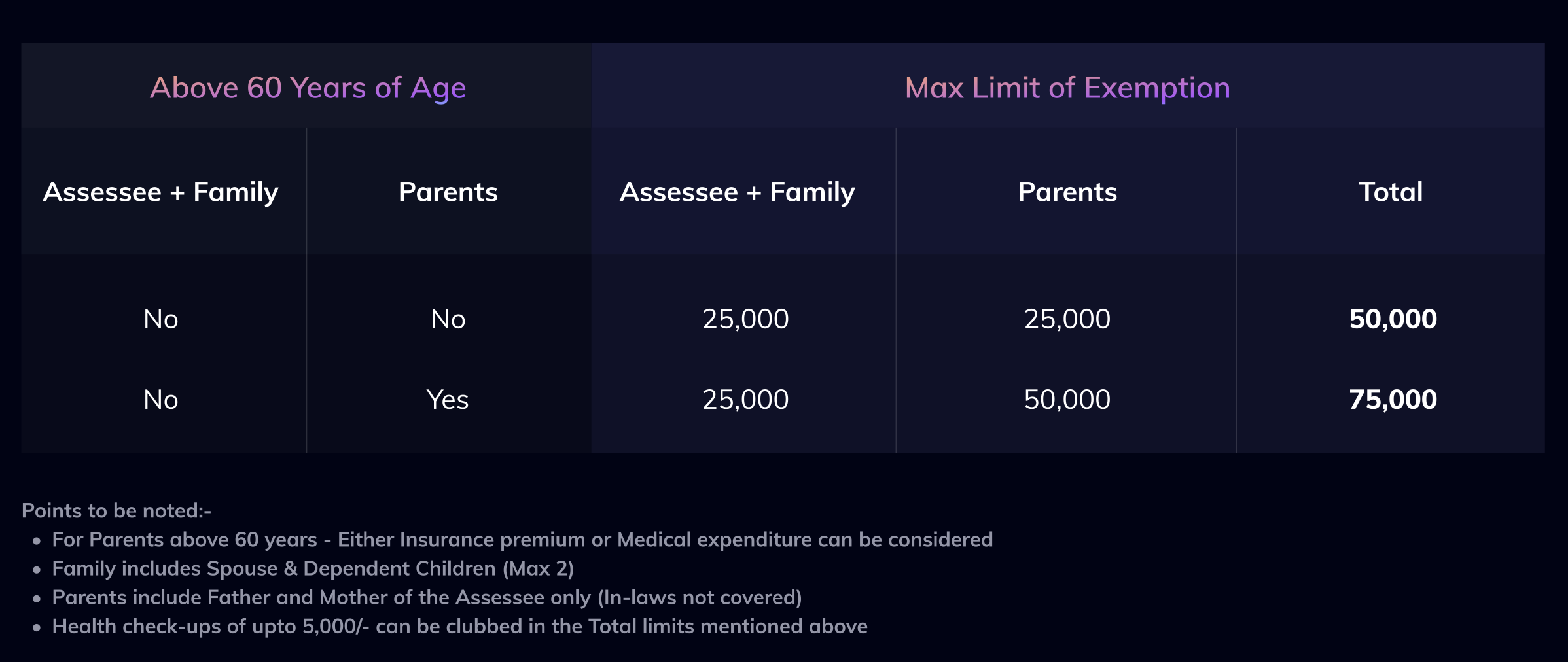
Section 80 allows deductions towards medical expenditure, insurance and disability claims.
**Medical Insurance Premium**:
Section 80D deductions are available only under the Old Tax Regime. The limits are as follows:
1. Up to ₹25,000 for premiums covering the taxpayer, spouse and dependent children, if all members are below 60 years.
2. Up to ₹50,000 if the taxpayer or spouse is a senior citizen (60 years or above).
3. Additional ₹25,000 for parents below 60 years or ₹50,000 if parents are senior citizens.
4. Preventive health check-ups of up to ₹5,000 are included within the above limits, not over and above them.
5. Maximum possible deduction is ₹1,00,000, when both the taxpayer and parents are senior citizens.
To submit proof:
* Submit the premium payments' receipt, copy of the policy that contain the details such as the name and age of the taxpayer's parents.
**Exemption Criteria/Criteria**:
Medical expenditure for training, treatment and others is exempt from tax upto a certain for your dependents with disabilities of various degrees.
* Flat ₹75,000 for disability conditions more than 40%
* Flat ₹1,25,000 for severe disability conditions more than 80%
* Dependent can be the taxpayer's parents, spouse, children and siblings.
* Dependent must not have claimed any deduction in the financial year.
**Proof Submission Best Practices**:
* Proof of expenditure incurred or a duly signed declaration in writing.
* Writing must certify the actual expenditure amount and receipt/ acknowledgment for the amount paid/deposited into the specified schemes of LIC/UTI.
* Permanent Physical Disability Cetificate (Form 10-IA) must be obtained from a physician, oculist, surgeon, psychiatrist.
* Certificate must bear the employee's name.
* Certificate/acknowledgement must contain the % of disability if it is a severe disability.
Deductions/exemptions under 80U are for the taxpayer's disabilities.
* Flat ₹75,000 for disability conditions more than 40%
* Flat ₹1,25,000 for severe disability conditions more than 80%
**Proof Submission Best Practices**:
* Permanent disability certificate (Form 10-I) must be obtained from a physician, oculist, surgeon, psychiatrist.
* Certificate must bear the employee's name.
* Certificate/acknowledgement must contain the % of disability if it is a severe disability.
 Section 80 allows tax exemption on interest on multiple loan repayments.
**Exemption Criteria/Criteria**:
Interest incurred on repayment of education loan is tax exempt in the following conditions:
* Interest incurred is on an education loan.
* Loan is availed by the employee for higher studies for self.
* Interest on repayment of up to 8 years/loan closure (whichever is earlier) is tax exempt.
* Principal loan amount is not exempt.
**Proof Submission Best Practices**:
Letter/certificate from the bank/financial institution certifying:
* Loan is an education loan.
* Amount of actual interest paid in the current financial year is exempt.
**Exemption Criteria/Criteria**:
Interest incurred on repayment of loan for purchase of residential house property is tax exempt in the following conditions:
* Loan was sanctioned between April 1, 2016 - March 31, 2017.
* Stamp value of the property does not exceed ₹50 lakhs.
* Loan amount does not exceed ₹35 lakhs.
* Taxpayer must not own any existing residential property at the time of house purchase.
* Interest of up to ₹50,000 is exempt.
* Principal loan amount is not exempt.
**Proof Submission Best Practices**:
Letter/certificate from the bank/financial institution certifying:
* Loan is a house loan.
* Amount of actual interest paid in the current financial year is exempt.
**Exemption Criteria/Criteria**:
Interest incurred on repayment of loan for purchase of certain house property is tax exempt in the following conditions:
* Loan was sanctioned between April 1, 2019 - March 31, 2022.
* Value of the property does not exceed ₹45 lakhs.
* Loan amount does not exceed ₹35 lakhs.
* Maximum interest of up to ₹1,50,000 is exempt.
* Principal loan amount is not exempt.
**Proof Submission Best Practices**:
Letter/certificate from the bank/financial institution certifying:
* Loan is a house loan.
* Amount of actual interest paid in the current financial year is exempt.
**Exemption Criteria/Criteria**:
Interest incurred on repayment of loan for purchase of electric vehicles is tax exempt in the following conditions:
* Loan was sanctioned between April 1, 2019 - March 31, 2023.
* Maximum amount of up to ₹1,50,000 is exempt.
* Loan must be taken for purchase of an electric vehicle of any kind.
**Proof Submission Best Practices**:
Letter/certificate from the bank/financial institution certifying:
* Loan is a house loan.
* Amount of actual interest paid in the current financial year is exempt.
Employee's contribution of ₹50,000 towards National Pension Scheme (NPS) is exempt. Balance amount (of ₹1.5 lakhs), that is, a total of ₹2 lakhs can be claimed under Section 80C.
Submit the NPS contribution receipt or the NPS account statement.
Any donations to trusts, funds, political parties and others are exempt under 80G to a certain limit.
Uploading 80G proofs is only possible if you allow employees' [80G contributions](/docs/payroll/tax-deductions-setup#disable-80g).
Proof of payment and receipt must be submitted.
Loan taken to construct a residential property can be claimed as tax exempt in the following conditions:
* Construction must be completed within 5 years.
* Maximum of ₹2,00,000 in interest paid for five years is spread out for the next five years to claim.
* Loan is before April 1, 1999: ₹30,000
* Loan is after April 1, 1999: ₹2,00,000
* Loan taken for repair, reconstruction, renewal: ₹30,000 is exempt.
* Loan must not be a personal loan taken for home use.
**Proof submission best practices**:
* Submit the provisional interest certificate issued by your bank that details the principal amount and the interest payable.
* Submit the posession certificate from builder/society/electricity bill/sale deed/municipal tax receipt.
Section 80 allows tax exemption on interest on multiple loan repayments.
**Exemption Criteria/Criteria**:
Interest incurred on repayment of education loan is tax exempt in the following conditions:
* Interest incurred is on an education loan.
* Loan is availed by the employee for higher studies for self.
* Interest on repayment of up to 8 years/loan closure (whichever is earlier) is tax exempt.
* Principal loan amount is not exempt.
**Proof Submission Best Practices**:
Letter/certificate from the bank/financial institution certifying:
* Loan is an education loan.
* Amount of actual interest paid in the current financial year is exempt.
**Exemption Criteria/Criteria**:
Interest incurred on repayment of loan for purchase of residential house property is tax exempt in the following conditions:
* Loan was sanctioned between April 1, 2016 - March 31, 2017.
* Stamp value of the property does not exceed ₹50 lakhs.
* Loan amount does not exceed ₹35 lakhs.
* Taxpayer must not own any existing residential property at the time of house purchase.
* Interest of up to ₹50,000 is exempt.
* Principal loan amount is not exempt.
**Proof Submission Best Practices**:
Letter/certificate from the bank/financial institution certifying:
* Loan is a house loan.
* Amount of actual interest paid in the current financial year is exempt.
**Exemption Criteria/Criteria**:
Interest incurred on repayment of loan for purchase of certain house property is tax exempt in the following conditions:
* Loan was sanctioned between April 1, 2019 - March 31, 2022.
* Value of the property does not exceed ₹45 lakhs.
* Loan amount does not exceed ₹35 lakhs.
* Maximum interest of up to ₹1,50,000 is exempt.
* Principal loan amount is not exempt.
**Proof Submission Best Practices**:
Letter/certificate from the bank/financial institution certifying:
* Loan is a house loan.
* Amount of actual interest paid in the current financial year is exempt.
**Exemption Criteria/Criteria**:
Interest incurred on repayment of loan for purchase of electric vehicles is tax exempt in the following conditions:
* Loan was sanctioned between April 1, 2019 - March 31, 2023.
* Maximum amount of up to ₹1,50,000 is exempt.
* Loan must be taken for purchase of an electric vehicle of any kind.
**Proof Submission Best Practices**:
Letter/certificate from the bank/financial institution certifying:
* Loan is a house loan.
* Amount of actual interest paid in the current financial year is exempt.
Employee's contribution of ₹50,000 towards National Pension Scheme (NPS) is exempt. Balance amount (of ₹1.5 lakhs), that is, a total of ₹2 lakhs can be claimed under Section 80C.
Submit the NPS contribution receipt or the NPS account statement.
Any donations to trusts, funds, political parties and others are exempt under 80G to a certain limit.
Uploading 80G proofs is only possible if you allow employees' [80G contributions](/docs/payroll/tax-deductions-setup#disable-80g).
Proof of payment and receipt must be submitted.
Loan taken to construct a residential property can be claimed as tax exempt in the following conditions:
* Construction must be completed within 5 years.
* Maximum of ₹2,00,000 in interest paid for five years is spread out for the next five years to claim.
* Loan is before April 1, 1999: ₹30,000
* Loan is after April 1, 1999: ₹2,00,000
* Loan taken for repair, reconstruction, renewal: ₹30,000 is exempt.
* Loan must not be a personal loan taken for home use.
**Proof submission best practices**:
* Submit the provisional interest certificate issued by your bank that details the principal amount and the interest payable.
* Submit the posession certificate from builder/society/electricity bill/sale deed/municipal tax receipt.