

Available in🇮🇳 India
On Payroll, you can automate paying your employees accurately and effortlessly. All payments are made directly to the employees’ bank accounts and are systematically recorded in the Salary Register.
Payroll Salary Actions
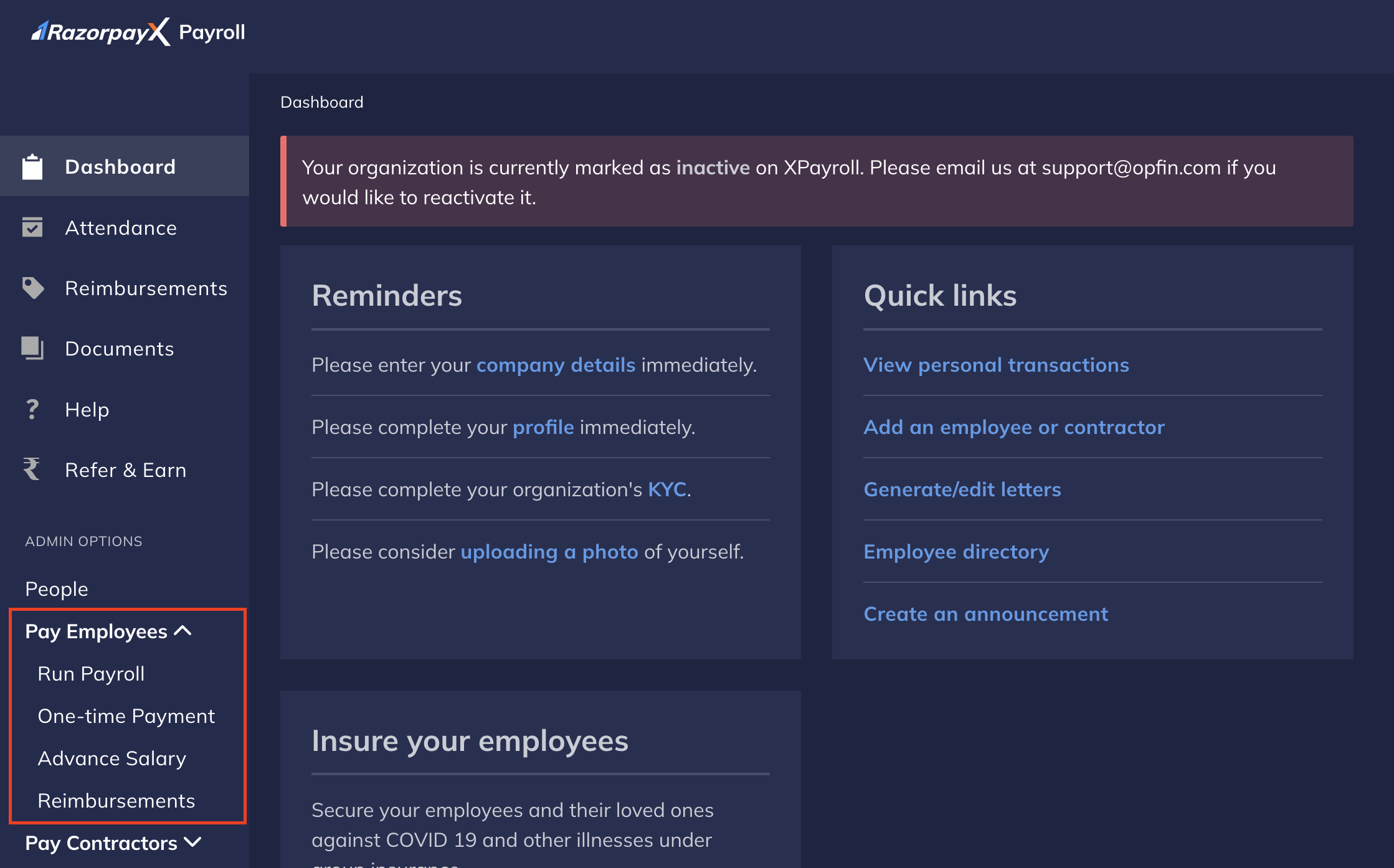
With Payroll, salary disbursals are timely, precise and efficient. It can pay your employees in the following ways:- Execute monthly payroll using Run Payroll.
- Make one-time payments, as necessary.
- Approve and pay Reimbursements.
- Approve and pay Advance Salary.
- Create bonuses and add clawbacks.
- Grant employee loans at the time of need.
- Provide flexible benefits to employees.
Setup Salary Structure
To pay salaries to your employees, you must first set up your salary structure for your organisation and configure flexible benefits for your employees. Know more about setting up a default salary structure.Setup Compensation
Learn how to set up the salary structure for your employees in Payroll.
Default Salary Structure
Configure organisation-wide default salary structure templates for efficient employee onboarding.
Manage Deductions
Configure recurring deductions and understand how they affect take-home salary.
Salary Revision
Process salary revisions with different effective dates and manage compensation changes.
Salary Structure Components
Salary Structure Components
A typical salary structure in Payroll consists of the following components:
- Fixed Components: These include basic salary, HRA and other fixed allowances that remain constant throughout the year.
- Variable Components: These are performance-linked components that may vary based on achievement of targets.
- Perquisites: These are benefits provided by the employer like car rental, accommodation and interest-free loans.
- Deductions: These include statutory deductions like PF, PT, ESI as well as voluntary deductions.
- Flexible Benefits: These allow employees to choose benefits according to their needs within a predefined limit.
CTC vs Take-home Salary
CTC vs Take-home Salary
Cost to Company (CTC) is the total amount the organisation spends on an employee, while take-home salary is what the employee actually receives after all deductions.
-
CTC includes:
- Fixed components (Basic, HRA, Special Allowance and so on)
- Variable components
- Employer contributions to PF, ESI, gratuity and so on.
- Value of perquisites provided
- Flexible benefits allocated
-
Take-home salary is CTC minus:
- Employee’s PF contribution
- Professional Tax
- Income Tax deducted at source (TDS)
- Other recurring deductions
- ESI (if applicable)
Salary Revision Process
Salary Revision Process
Salary revisions can be implemented for various reasons including promotions, annual increments or performance-based hikes. The process includes:
- Planning the revision structure (percentage increase, component-wise adjustment)
- Setting the effective date for the revision
- Updating the salary structure in the system
- Communicating the changes to the employee
Setup Compensation
Setting up an employee’s compensation requires configuring various components that make up the total CTC. To set up an employee’s salary:- Log into the Payroll Dashboard.
- Navigate to People from the left menu.
- Select the employee for whom you want to set up the salary.
- Click on the Compensation tab.
- Click EDIT to modify the compensation details.
- In the Annual CTC field, enter the total cost to company.
- Configure the breakdown of fixed components:
- Basic Salary
- House Rent Allowance (HRA)
- Special Allowance
- Other allowances as applicable
- If there are variable components, specify the terms and conditions for variable pay.
- Click CONTINUE to save the compensation structure.
Salary Revision
Salary revisions allow you to update an employee’s compensation with proper tracking and effective dates.Add Salary Revision Without Effective Date
Add Salary Revision Without Effective Date
When you need to implement a salary revision immediately:
- Log in to the Payroll Dashboard.
- Navigate to People from the left menu.
- Open the employee’s profile and navigate to their Compensation tab.
- Click Revise CTC button to initiate the revision process.
- In the revision form:
- Enter the new Annual CTC amount.
- Adjust the breakdown of components as required.
- Leave the effective date field empty for immediate implementation.
- Click CONTINUE to proceed.
- Review the changes and click CONFIRM to apply the revision.
Add Mid-month Effective Date Revision
Add Mid-month Effective Date Revision
For salary revisions effective from a specific date in the current month:
- Log in to the Payroll Dashboard.
- Navigate to People from the left menu.
- Open the employee’s profile and navigate to their Compensation tab.
- Click Revise CTC button.
- In the revision form:
- Enter the new Annual CTC amount.
- Adjust the breakdown of components as required.
- Set the Effective From date to the specific date in the current month.
- Click CONTINUE to proceed.
- Review the changes and click CONFIRM to apply the revision.
Schedule Future Salary Revision
Schedule Future Salary Revision
To schedule a salary revision effective from a future date:
- Log in to the Payroll Dashboard.
- Navigate to People from the left menu.
- Open the employee’s profile and navigate to their Compensation tab.
- Click Revise CTC button.
- In the revision form:
- Enter the new Annual CTC amount.
- Adjust the breakdown of components as required.
- Set the Effective From date to a future date.
- Click CONTINUE to proceed.
- Review the changes and click CONFIRM to schedule the revision.
Remove Salary Revision
Remove Salary Revision
If you need to cancel a scheduled salary revision or revert a recent revision:
- Log in to the Payroll Dashboard.
- Navigate to People from the left menu.
- Open the employee’s profile and navigate to their Compensation tab.
- Locate the salary revision entry and click the delete icon.
- In the confirmation dialog:
- Review the information about what will happen after removal.
- Click CONFIRM to remove the revision or CANCEL to go back.